

As wildfires become more frequent and severe due to climate change, emergency response agencies are increasingly turning to artificial intelligence (AI) and autonomous drone technology to improve early fire detection and response.
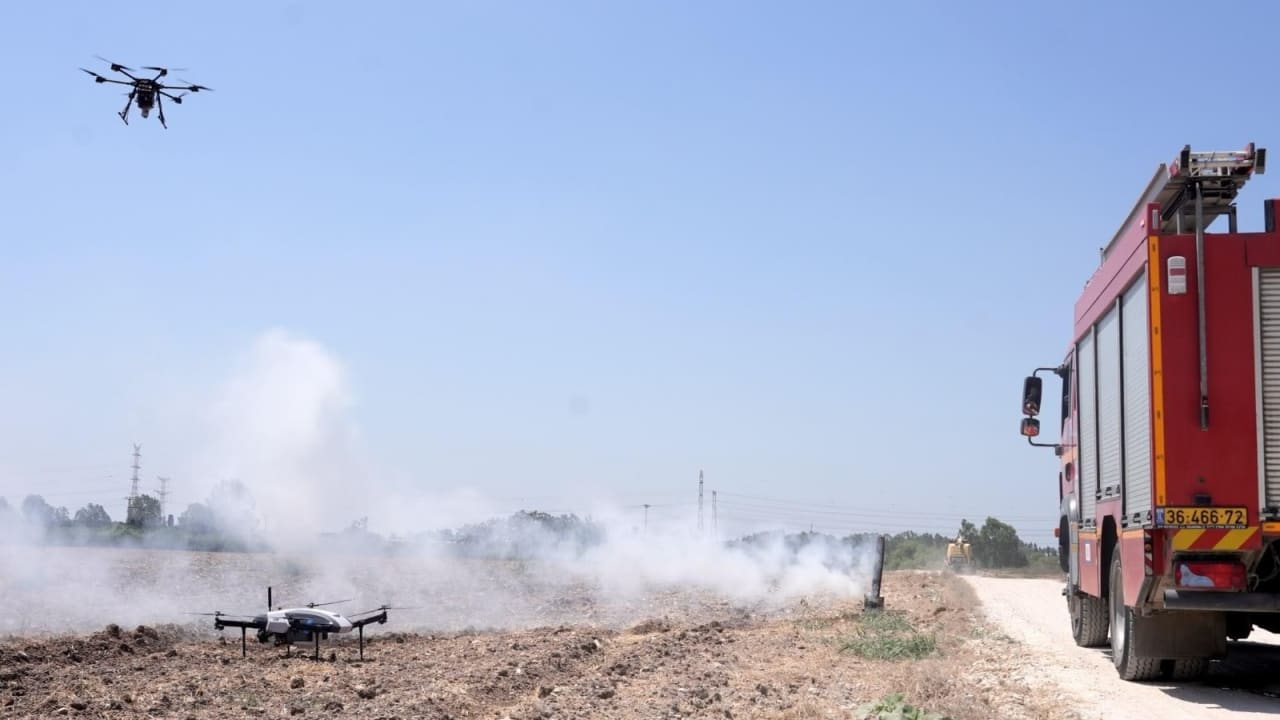
A new AI-powered vertical take-off and landing (VTOL) drone has completed its first successful test flight as part of a collaborative initiative involving Israel’s National Security Ministry, Israel Aerospace Industries (IAI), the Technion, the Israel Innovation Authority and the Fire and Rescue Authority.
The project aims to enable real-time detection and reporting of wildfires within minutes of ignition using advanced AI algorithms, thermal imaging and autonomous flight capabilities.
AI delivers real-time fire detection
The system is designed to detect and accurately locate fires during both day and night operations. Using infrared sensors and advanced image-processing algorithms, the drone can identify fire sources even through dense smoke and immediately transmit alerts to the Fire and Rescue Authority’s command centre.
Developers say the technology addresses one of the biggest challenges in wildfire management: maintaining a real-time operational picture across large, remote and difficult-to-access areas while enabling faster emergency response.
Autonomous drone operation
The fire detection system is installed on IAI’s APUS 25 tactical drone, a VTOL platform capable of operating without a runway.
Before deployment, operators define the surveillance area by marking it on a digital map. Once airborne, the drone flies autonomously to its assigned position and continuously scans the area for four to five hours, providing emergency teams with live situational awareness and accurate fire location data.
The aircraft combines long-endurance flight with high-altitude surveillance while maintaining its operational range through an internal combustion engine that eliminates the need for heavy batteries or electric propulsion systems.
Advanced imaging and AI analytics
The platform integrates multiple technologies to improve detection accuracy, including:
- Infrared day and night imaging
- AI-powered image analysis
- Spectral algorithms for fire detection
- Automatic anomaly detection
- Real-time geolocation of fire outbreaks
- Live transmission of alerts to emergency command centres
These capabilities allow emergency services to identify fires in their earliest stages and deploy resources more quickly.
Supporting faster emergency response
Project partners believe combining autonomous drones with AI and advanced data processing will significantly improve wildfire monitoring, incident management and operational decision-making.
Beyond detecting fires, the system provides emergency responders with a continuous real-time operational picture, helping coordinate firefighting resources more effectively while reducing response times.
As climate-related wildfire risks continue to increase worldwide, autonomous aerial surveillance systems are expected to play an increasingly important role in protecting communities, infrastructure and natural ecosystems.
