

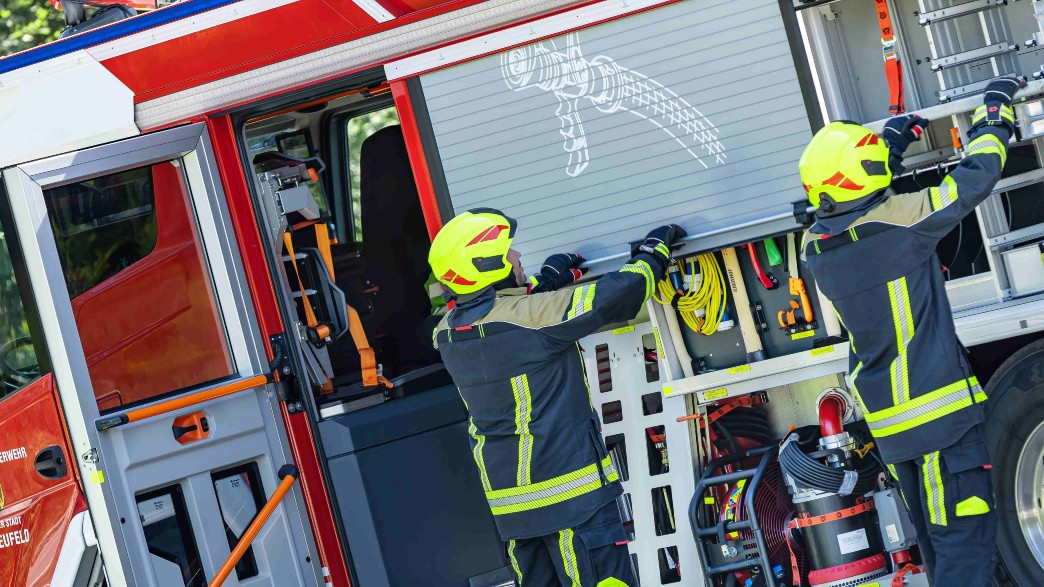
An all-electric fire engine has demonstrated the potential to improve emergency response times and firefighting efficiency, following a year-long trial conducted by Fire Rescue Victoria (FRV) in Melbourne.
The trial found that the electric Rosenbauer RT arrived at emergency incidents faster than conventional diesel-powered fire engines in 72% of 424 real-world emergency responses. On average, the electric vehicle reduced arrival times by 26 seconds, while also making essential firefighting equipment available sooner.
Conducted throughout 2025, the evaluation compared the electric fire engine with vehicles from FRV’s existing fleet across two operational environments.
The first phase involved 283 emergency call-outs from Eastern Hill Fire Station, which serves Melbourne’s densely populated inner-city area, characterised by high-rise buildings and heavy traffic. The second phase covered 141 deployments from Brooklyn Fire Station, serving suburban and industrial communities.
The Rosenbauer RT recorded an average response time of three minutes and 42 seconds, compared with four minutes and eight seconds for conventional diesel fire engines. The performance advantage was particularly noticeable on longer journeys.
The trial also highlighted significant improvements in equipment deployment times. Extinguishing water was available in an average of 10.36 seconds after arrival, compared with 33.27 seconds for diesel-powered vehicles. Respiratory protection equipment was ready in 55.11 seconds, against 70.66 seconds for conventional fire engines. Medical equipment was also accessible approximately seven to nine seconds sooner.
Beyond response performance, the evaluation considered firefighter experience, vehicle usability and working conditions. Some 83% of participating firefighters rated entering and exiting the electric fire engine more favourably than conventional vehicles. Its user-friendliness received an average score of 8.01 out of 10, with reduced noise and vibration levels also identified as key benefits.
The financial case for electrification was another important finding. An independent cost-benefit assessment conducted by Deloitte Access Economics estimated that every additional Australian dollar invested in the electric fire engine generated A$2.01 in annual financial benefits, primarily through reduced property damage resulting from faster firefighting operations.
When broader public health and safety benefits were included, the estimated return increased substantially to A$20.70 for every additional dollar invested.
The assessment further indicated that the additional purchase costs of the electric vehicle could be recovered within approximately six years.
The Melbourne trial provides encouraging evidence that electric emergency vehicles can deliver more than environmental benefits. By improving response times, accelerating equipment deployment and potentially reducing long-term operational costs, the Rosenbauer RT could offer a compelling option for fire services exploring the transition towards more sustainable emergency response fleets.
