

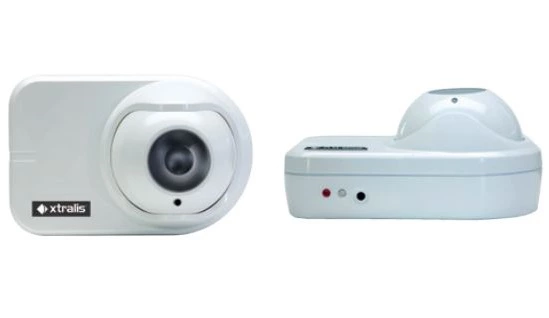
Fire detection and alarm systems play a vital role in identifying fires at an early stage, allowing occupants to evacuate safely while enabling emergency responders to contain incidents before they escalate. Alongside conventional smoke, heat and flame detectors, projected beam smoke detectors have become an increasingly important solution for protecting large, open spaces where traditional point detectors may be less effective.
This article examines how projected beam smoke detectors operate and compares their installation requirements under NFPA 72 and EN 54-14, highlighting key design considerations for engineers, system designers and installers.
How Beam Smoke Detectors Work
Projected beam smoke detectors operate using the principle of light obscuration. A transmitter emits a beam of light across a protected area toward either a receiver or a reflector. When smoke enters the beam path, it reduces the amount of light reaching the receiver. Once this reduction exceeds a predetermined threshold, the detector generates an alarm.
Because they monitor large areas with a single beam, these detectors are particularly suited to warehouses, factories, aircraft hangars, atriums, exhibition halls and other buildings with high ceilings where smoke may take longer to reach conventional point detectors.
NFPA 72 (2022) defines a beam detector as “a type of photoelectric light obscuration smoke detector wherein the beam spans the protected area.” Similarly, EN 54-14 describes beam detectors as optical devices designed to detect smoke by monitoring the obscuration of a projected light beam.
Why Beam Detectors Are Used
Beam smoke detectors are commonly installed where conventional detectors become impractical due to building height or large open spaces.
Typical applications include:
- Warehouses
- Manufacturing plants
- Distribution centres
- Shopping malls
- Sports arenas
- Aircraft hangars
- Churches
- Exhibition centres
- Large atriums
In these environments, smoke can stratify before reaching ceiling-mounted point detectors, making beam technology a more effective early-warning solution.
Environmental Factors Affecting Performance
Like all smoke detection technologies, beam detectors are influenced by environmental conditions.
According to NFPA 72 Annex A.17.7.1.8, factors affecting detector performance include:
- Relative humidity above 93%
- Temperatures below 0°C or above 37.8°C
- Dust accumulation
- Building movement
- Obstructions along the beam path
Unlike ionisation and photoelectric detectors, air velocity and altitude generally have minimal influence on beam detector performance.
Regular maintenance and correct alignment remain essential to ensure reliable operation.
NFPA 72 Installation Requirements
NFPA 72 provides detailed guidance for installing projected beam smoke detectors while emphasising compliance with the manufacturer’s published instructions.
Key installation requirements include:
- Maximum beam spacing of 18.3 metres (60 ft) for smooth ceilings.
- Distance from a parallel wall should not exceed 0.5S, where S represents beam spacing.
- Distance from the end wall should not exceed 0.25S.
- Detectors should be installed at least 910 mm (36 inches) away from HVAC supply diffusers and return air openings.
- Maximum beam length must comply with the manufacturer’s specifications.
Although NFPA 72 does not prescribe a universal mounting height, manufacturer documentation generally recommends installing beam detectors 300–600 mm below the ceiling, with the detector positioned no more than 10% of the floor-to-ceiling height below the ceiling.
Most UL-listed manufacturers specify maximum beam lengths of approximately 100 metres.
EN 54-14 Installation Requirements
EN 54-14 adopts a more application-focused approach, particularly for large buildings and high-ceiling environments.
The standard recommends beam detectors for ceiling heights of up to 16 metres under normal conditions. For structures between 16 and 45 metres, installation depends on fire behaviour, smoke movement and engineering assessment.
Key recommendations include:
- Maximum detection radius of 6.2 metres
- Maximum detector spacing of 8.8 metres
- Detector installation within 10% of ceiling height, typically no more than 600 mm below the ceiling
- Equipment positioning based on documented system design
For atriums and high-ceiling spaces, EN 54-14 recommends installing beam detectors between 9 and 12 metres above floor level, while recognising that spacing should be adjusted according to installation height and smoke behaviour.
Manufacturers producing EN-compliant beam detectors commonly offer operational beam ranges between 100 and 200 metres, depending on the product.
Comparing NFPA 72 and EN 54-14
Although both standards share the same objective of ensuring reliable smoke detection, they differ in their design philosophy.
NFPA 72 places greater emphasis on:
- Installation geometry
- Horizontal beam spacing
- Environmental limitations
- Manufacturer compliance
EN 54-14 focuses more on:
- Application-specific design
- High-ceiling environments
- Smoke behaviour
- Engineering assessment
Despite these differences, both standards consistently recommend positioning beam detectors approximately 300–600 mm below the ceiling and highlight the importance of correct alignment, unobstructed beam paths and manufacturer installation requirements.
Manufacturer Specifications Remain Critical
While NFPA 72 and EN 54-14 provide the framework for system design, many critical installation parameters are ultimately determined by manufacturers.
These include:
- Maximum beam distance
- Detector sensitivity
- Mounting height
- Reflector positioning
- Environmental tolerances
- Alignment procedures
Because performance varies between products, engineers should always consult the manufacturer’s certified installation documentation alongside applicable standards.
Best Practice for System Design
Successful beam smoke detector installations require more than simply following code requirements. Designers should consider:
- Ceiling height
- Building geometry
- Air movement
- Smoke stratification
- HVAC airflow
- Potential obstructions
- Maintenance accessibility
- Manufacturer recommendations
Proper planning ensures reliable detection performance while reducing false alarms and maintenance issues.
Conclusion
Projected beam smoke detectors remain one of the most effective fire detection solutions for protecting large-volume and high-ceiling buildings. Their ability to monitor extensive areas using photoelectric light obscuration technology makes them particularly valuable where conventional point detectors are less effective.
While NFPA 72 and EN 54-14 provide comprehensive guidance on installation and system design, neither standard should be used in isolation. Effective beam smoke detection requires careful consideration of both regulatory requirements and manufacturer-specific technical documentation.
Ultimately, successful system design depends on sound engineering judgement, correct installation practices and regular maintenance to ensure reliable fire detection throughout the life of the system.
