

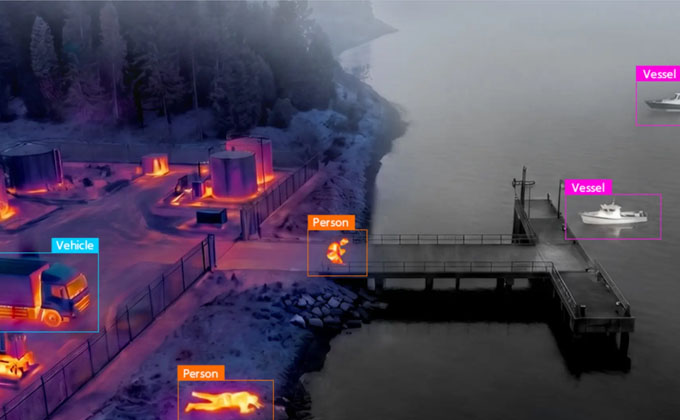
Hanwha Vision has introduced a new VGA AI Tele lens Thermal Camera series designed to improve long-range surveillance across land and maritime security environments. The system combines high-sensitivity thermal imaging with on-device artificial intelligence (AI), enabling the detection and classification of people, vehicles and vessels in challenging visibility conditions.
High-Sensitivity Thermal Imaging
A key feature of the new series is its NETD of ≤16mK at 25°C. Noise Equivalent Temperature Difference (NETD) is an important performance indicator for thermal cameras because lower values indicate greater sensitivity to small temperature differences.
The VGA models use an uncooled 640 × 480 microbolometer operating across the 8–14µm spectral range. This enables the cameras to detect thermal signatures in conditions where conventional visible-light cameras can become less effective, including darkness, fog and other low-visibility environments.
The technology is suited to applications such as critical infrastructure protection, perimeter surveillance, border monitoring, coastal security and port protection.
AI-Based Object Detection
The cameras integrate AI analytics to distinguish between different object types. Person, vehicle and vessel detection allows security operators to focus on potentially relevant events rather than continuously monitoring large volumes of video.
According to Hanwha Vision, the enhanced thermal sensitivity also helps the AI system classify people in challenging positions, including partially obscured, crouching or prone individuals.
For maritime applications, vessel detection adds another layer of automated situational awareness. The system can identify vessels alongside people and vehicles, making it suitable for coastal surveillance, ports and maritime border-control applications. The 60mm model, for example, lists AI detection distances of up to 1,486m for vessels under the manufacturer’s specified conditions.
Multiple Lens and Frame-Rate Options
The series is available with different telephoto lens configurations, allowing security integrators to select a field of view and detection capability appropriate to the deployment environment.
The 60mm model provides a 10.3° horizontal field of view and supports up to 30fps, with output resolutions including 1280×960 and 640×480. This combination is designed for applications where long-range thermal observation and smooth motion capture are important.
Built for Harsh Outdoor Environments
Outdoor security systems must continue operating under demanding environmental conditions. Hanwha’s cameras incorporate IP66/IP67, NEMA 4X and MIL-STD-810H ratings, providing protection against water, dust and environmental stresses.
The ruggedised design is particularly relevant to perimeter security, coastal infrastructure, industrial sites and other installations exposed to rain, humidity, vibration and salt environments.
Cybersecurity Built Into the Camera
Cybersecurity is another important component of modern networked surveillance. The series incorporates a FIPS 140-3 Level 3 Secure Element, providing hardware-based security capabilities, while encryption features are designed to protect stored surveillance data.
This is increasingly important as thermal cameras become connected components within wider IP surveillance and security-management systems.
Expanding Intelligent Thermal Surveillance
The development reflects the wider movement towards intelligent video surveillance, where thermal sensors, AI analytics, cybersecurity and ruggedised hardware are integrated into a single security platform.
For security operators, the combination can provide continuous monitoring in darkness and poor visibility while reducing dependence on manual video observation. As critical infrastructure, ports, borders and industrial facilities face increasingly complex security requirements, AI-enabled thermal imaging is likely to become an increasingly important component of perimeter and situational-awareness systems.
Hanwha Vision’s new series therefore represents more than an incremental camera upgrade: it demonstrates how thermal sensitivity, AI classification, long-range optics and cybersecurity are converging to create more intelligent and resilient surveillance systems.
