

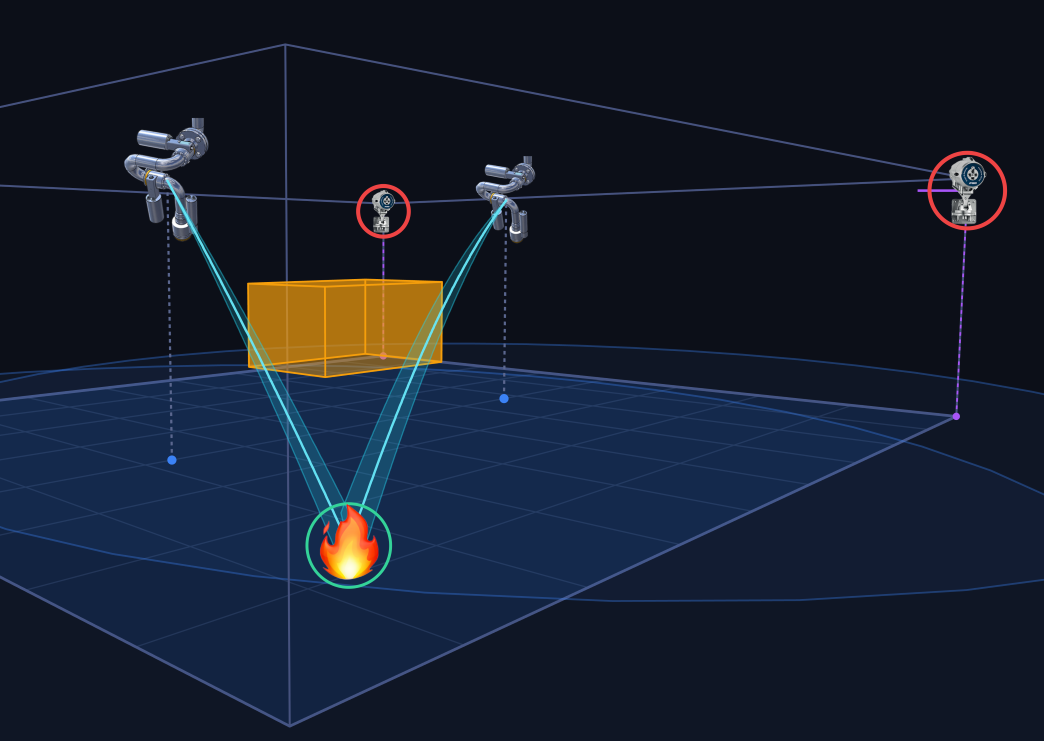
Every fire protection system is ultimately judged by one critical moment: the first few seconds after a fire starts. These initial moments can determine whether a fire is rapidly contained or escalates into a major emergency. However, the effectiveness of that response is not determined when the fire breaks out. It is engineered months earlier, through the design, integration and optimisation of the protection system.
As industrial facilities grow in size and complexity, the demands placed on fire protection systems continue to increase. Autonomous Robotic Fire Suppression Systems (ARFSS), such as Unifire AB’s FlameRanger™, bring together robotic nozzles, multiple fire detection technologies and distributed control systems to deliver a coordinated, autonomous response.
Designing these systems requires much more than selecting equipment and positioning components on a drawing. It demands a comprehensive understanding of how every element will interact under real operating conditions.
Beyond the Drawing Board
The engineering challenge is no longer simply determining whether a robotic nozzle can reach a particular area. Engineers must consider multiple interconnected factors, including suppression coverage, nozzle overlap, detector integration, autonomous nozzle selection, water utilisation and the overall behaviour of the system as an integrated network.
Digital engineering provides the foundation for addressing these challenges.
To support the engineering of every FlameRanger project, Unifire has developed a proprietary digital engineering environment that enables complete Autonomous Robotic Fire Suppression Systems to be designed, analysed, simulated, optimised and documented in a virtual environment before installation begins.
Using detailed three-dimensional facility models, Unifire’s engineers can assess nozzle reach, detector visibility, suppression coverage and potential blind spots. This allows design limitations to be identified and addressed long before equipment reaches the site.
The real advantage of digital engineering lies in making better-informed decisions. Alternative equipment layouts, detector configurations, suppression strategies and levels of redundancy can be evaluated in minutes rather than days.
This makes it possible to optimise each project against its specific operational requirements rather than simply settling for a design that meets minimum specifications. It also gives facility owners and consulting engineers greater visibility of the technical benefits and implications of different design approaches before equipment is purchased or installed.
Verifying Performance Before Installation
Simulation takes this engineering process a step further.
By creating virtual fire scenarios, engineers can evaluate how an Autonomous Robotic Fire Suppression System is expected to respond before commissioning. Simulated fire events allow detection devices to identify the fire, control logic to select the appropriate robotic nozzles, and the resulting suppression strategy to be assessed and refined within the digital environment.
This provides an opportunity to evaluate system behaviour, identify potential weaknesses and optimise performance before the physical installation begins.
Digital engineering also improves consistency and documentation. Because system drawings, hydraulic calculations, detector layouts and bills of materials are generated from the same underlying engineering model, information remains aligned throughout the design process. This reduces duplication, accelerates documentation and minimises opportunities for engineering errors.
Engineering Confidence Before the First Flame
This approach has shaped the continued development and implementation of FlameRanger™ Autonomous Robotic Fire Suppression Systems.
Every FlameRanger project is digitally engineered from the earliest proposal stage. This enables Unifire’s engineers to optimise detector positioning, suppression overlap, network response and overall system performance before the first component is installed.
As industrial fire protection requirements become increasingly demanding, digital engineering will play an essential role in the next generation of autonomous fire suppression technology. The ability to model, simulate and optimise an entire system before installation represents a significant step towards more reliable, effective and intelligently engineered fire protection.
Ultimately, the first 15 seconds of a fire incident should not be left to chance. They should be the result of careful planning, precise engineering and rigorous design verification
