

Building safety depends on effective fire protection measures, and ventilation systems play a critical role. However, if ductwork is not correctly designed and detailed, it can become a pathway for fire and smoke to spread throughout a building.
Fire dampers are essential fire safety devices designed to help maintain compartmentation, protect escape routes, and reduce the risk of fire spreading between different areas of a building.
Understanding how fire dampers work, how they are classified, and why correct selection, installation, and maintenance matter is vital for building owners, designers, contractors, and facilities managers.
What Are Fire Dampers?
Fire dampers are installed within ventilation ductwork where it passes through fire-resisting walls or floors. Their primary purpose is to maintain the fire resistance of the compartment barrier by closing the duct opening when exposed to fire, helping prevent flames from spreading through the ventilation system.
Correct selection and installation are essential to ensure that the damper performs as intended during a fire.
How Do Fire Dampers Work?
Fire dampers operate using different mechanisms, depending on their design and application.
1. Fusible-link fire dampers
Traditional fire dampers commonly use a fusible link designed to release at a specified temperature, often around 72°C, depending on the product. When the link melts, a spring mechanism or gravity-operated arrangement closes the damper blades, restricting the passage of fire through the ductwork.
2. Motorised fire dampers
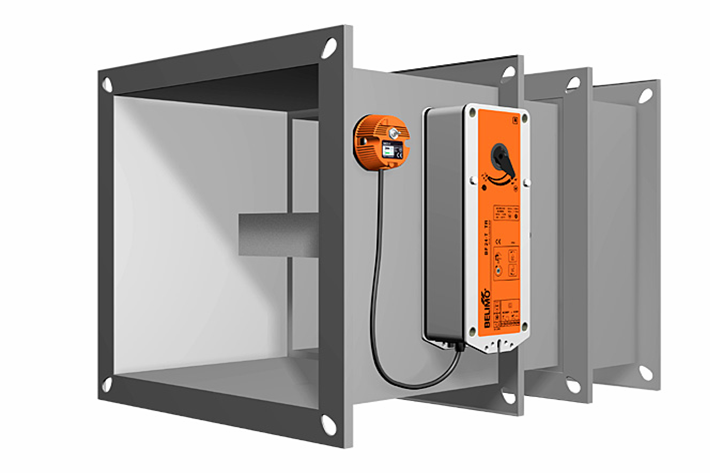
Motorised fire dampers use an electrical actuator to operate the damper. Many designs feature a power-open, spring-return mechanism, allowing the damper to return to its designated safe position when power is removed.
When integrated with a fire alarm or fire damper control system, these dampers can support automatic operation, remote testing, fault monitoring, and clear status indication.
The appropriate damper type depends on the building’s fire strategy, the installation conditions, and the manufacturer’s tested configuration.
What Is the Role of a Fire Damper Control System?
A fire damper control system provides centralised monitoring, testing, and control of compatible motorised fire dampers. It helps ensure that dampers operate in accordance with the building’s fire strategy and supports routine maintenance and compliance documentation.
Depending on the system configuration, key functions may include:
Automatic operation: Commands compatible motorised dampers to move to their designated fire position when triggered by an appropriately integrated fire alarm or control system.
Status monitoring: Provides open, closed, and fault indications to help building operators identify operational issues.
Routine testing: Enables scheduled functional testing, reducing the need for manual intervention at every damper.
Fault reporting: Identifies failures and maintenance requirements, particularly for dampers installed in concealed or difficult-to-access locations.
Compliance records: Helps maintain evidence of testing, faults, and maintenance activities.
A control system supports fire safety management, but it does not replace correct damper selection, compliant installation, or physical inspection and maintenance.
What Testing Standards Apply to Fire Dampers?
Fire dampers must be tested and classified in accordance with the applicable standards and installed within the scope of their approved configurations.
Important European standards include:
EN 1366-2 – Fire Resistance Tests for Service Installations: Fire Dampers: Specifies the fire resistance testing method for fire dampers.
EN 13501-3 – Fire Classification of Construction Products and Building Elements: Provides the classification framework for fire-resisting dampers and other relevant service installations based on applicable test results.
EN 15650 – Ventilation for Buildings: Fire Dampers: Specifies product requirements for fire dampers within its scope and is relevant to applicable product conformity and market-access requirements.
The applicable conformity-marking requirements depend on the product, market, and current regulations. In the UK, CE or UKCA marking requirements should be verified against the relevant legislation and current guidance.
Control systems must also be suitable for their intended application and comply with applicable requirements for reliable operation, monitoring, and fail-safe behaviour.
Always consult the current standards, product documentation, and local fire safety regulations before specifying or installing a fire damper.
What Do Fire Damper Classifications Mean?
Fire damper classifications describe performance under specified test conditions. The classification indicates the functions achieved and the duration for which the relevant performance criteria were demonstrated.
The main terms include:
E – Integrity: Measures the ability to prevent flames and hot gases from passing through the separating element under the specified test conditions.
EI – Integrity and Insulation: Covers integrity and limits heat transfer to the non-fire side within the applicable classification criteria.
EIS – Integrity, Insulation and Smoke Leakage: This designation is used in certain classification or specification contexts where smoke leakage performance is also addressed. The exact meaning and applicability must be verified against the relevant standard and product documentation.
Fire resistance classifications commonly include periods such as 60, 90, and 120 minutes, where applicable.
For example, EI 60 indicates integrity and insulation performance for 60 minutes under the applicable test and classification conditions.
It is important to verify the complete classification, including any additional designations and conditions of use, rather than relying on a rating alone.
Why Is Correct Fire Damper Selection Crucial?
Fire dampers are tested for specific installation conditions. Selecting a product that falls outside its tested or approved scope can compromise its expected performance and undermine compliance.
Key selection considerations include:
Required fire resistance: The specified classification and duration, based on the building’s fire strategy.
Supporting construction: Whether the damper is installed in masonry, concrete, drywall, or a particular shaft-wall system.
Installation orientation: Whether the application requires a vertical or horizontal installation.
Duct connections: The permitted connection type and any requirements for rigid, flexible, or breakaway connections.
Airflow and pressure: The operating conditions the damper is designed to accommodate.
Access and maintenance: Whether the installation allows the required inspection, testing, and servicing.
The selected damper must be suitable for the actual site conditions and installed according to the manufacturer’s documented requirements.
Why Is Correct Fire Damper Installation Critical?
Even a correctly specified fire damper may fail to perform as intended if it is installed incorrectly.
Common installation errors include:
Incorrect fixing methods or fixing spacings.
Installation in an unapproved wall or floor construction.
Incorrect damper orientation.
Duct connections that interfere with blade movement.
Inadequate access for inspection, testing, and maintenance.
Failure to follow the manufacturer’s installation instructions.
Every detail matters. The supporting construction, fixings, clearances, duct connections, and fire-stopping arrangements must match the tested or approved installation details.
Is the Sealing Method Important for Fire Damper Installation?
Yes. The gap between a fire damper and the surrounding wall or floor is an important part of the installation detail.
The sealing arrangement must use materials and methods permitted by the applicable tested or approved configuration. This includes the specified fire-stopping products, seal depth, density, clearances, and application method.
Substituting materials or changing the installation detail without appropriate technical approval can compromise fire resistance.
Incorrect sealing may result in:
Fire and hot gases penetrating around the damper.
Loss of integrity before the required fire resistance period is achieved.
Excessive heat transfer where insulation performance is required.
Failure to meet the intended fire compartmentation requirements.
Fire stopping should therefore be treated as an integral part of the fire damper installation, not as a finishing detail.
What Are the Consequences of Incorrect Fire Damper Installation?
Incorrect selection, installation, sealing, testing, or maintenance can undermine the performance of the entire fire protection strategy.
Potential consequences include:
Rapid spread of fire and smoke between compartments.
Increased risk to occupants and emergency escape routes.
Failure to meet applicable fire safety requirements.
Enforcement action, legal liability, or prosecution where applicable.
Expensive remedial work and disruption to building operations.
Potential insurance complications, depending on the policy and circumstances.
Most importantly, an increased risk of injury or loss of life.
Fire dampers are life-safety components. Their effectiveness depends not only on the product itself, but also on correct specification, installation, commissioning, inspection, and maintenance.
Conclusion: Getting Fire Dampers Right Matters
Fire dampers play a vital role in maintaining fire compartmentation and limiting the spread of fire through ventilation systems. Understanding their operation, classifications, testing standards, and installation requirements helps ensure that they perform as intended in an emergency.
For building owners, designers, contractors, and facilities managers, the priorities are clear: select the correct damper, follow the manufacturer’s tested installation details, use the appropriate fire-stopping system, and establish a suitable programme of inspection, testing, and maintenance.
A fire damper is only as effective as its selection, installation, and ongoing maintenance. Getting these details right helps protect buildings, support compliance, and, above all, save lives.
